The Med School Application Timeline, Month by Month (Free Checklist)
Heads up: links to Med Mapped go to my own Etsy shop. I make a little if you buy, and the free printable here stays free either way.
The med school application isn't one deadline. It's about eighteen months of smaller ones that stack on top of each other: an MCAT date, letter requests, a personal statement, a primary application, a pile of secondaries, interviews, and then a long wait. Most of the stress comes from not knowing what's next, not from any single step. The good news? That part is totally fixable!
So here's the whole thing on one timeline, the way I'd lay it out for a friend applying next cycle. The dates in bold come from the AAMC's 2027 AMCAS cycle. The AAMC posts each new cycle's dates in the spring, and they've landed in roughly the same weeks for years, so use them as your planning anchors and confirm the exact days when the new ones are out.
The 2027 AMCAS dates to anchor on
| Date (2027 cycle) | What happens |
|---|---|
| May 5 | The AMCAS application opens. You can start filling it in. |
| May 28 | You can submit. |
| June 26 | AMCAS starts sending verified applications to schools. |
| August 3 | Early Decision deadline (one school, all materials in). |
| Sept to Dec | Regular deadlines, which vary by school. |
Source: the AAMC's 2027 AMCAS applicant webinar slides.
Two things about those dates matter more than they look. First, AMCAS has to verify your coursework before any school sees your application, and the AAMC says that can take about six weeks in the busy season once your application is ready for review and your transcripts have arrived. Second, most schools review on a rolling basis, so an application that shows up in July is read while there are still plenty of interview spots. Submitting early in the window is the single biggest timing advantage you control, so it's worth planning for!
A year out (the summer before you apply)
- Pick your MCAT date. Leave room for a retake. Scores come back about a month after the exam, and you want a score in hand before you build your school list.
- Start an activity log. AMCAS gives you up to 15 Work and Activities entries and lets you mark up to 3 as Most Meaningful. You'll need dates, hours and a contact for each one. Trust me, it's so much easier to write these down now than to dig them up later!
- Keep your clinical and volunteer hours going. Schools care more about steady involvement than a big burst right before applying.
Fall and winter before you apply
- Study for and take the MCAT if you haven't. For the 2027 testing year, AAMC lists the registration fee at $360 ($145 with the Fee Assistance Program).
- Ask for letters. Ask early, ask in person or by a real email, and give each writer your CV, a short note on what you'd like them to speak to, and a deadline a few weeks before you actually need it. AMCAS lets you enter up to 10 letters, and most applicants send two or three, so check each school's requirements.
- Apply for the Fee Assistance Program before you register for anything. FAP benefits aren't retroactive. If you qualify, it waives AMCAS fees for up to 20 schools and lowers the MCAT fee, so the order really matters!
January to April
- Write the personal statement. You get 5,300 characters, spaces included. Plan on several drafts (that's totally normal!), and have at least one reader who doesn't know you well.
- Draft your activity descriptions (700 characters each, plus extra room for the three Most Meaningful).
- Build a first school list. Use mission, location, cost and your stats against each school's numbers in the AAMC's MSAR. Put every school, its secondary fee and its deadline in one place. This is where most people's spreadsheets start!
May and June: the primary application
- Fill in AMCAS as soon as it opens and request transcripts from every college you attended right away, since verification can't start without them.
- Submit as close to the opening week as you can while still turning in something you're proud of. A clean application in early June beats a rushed one on day one. Breathe, you have time!
- Pre-write your secondaries. Many schools reuse the same few prompt types year to year: why this school, a challenge you faced, diversity and what you'd add to the class, and what you did during gap years. Draft one strong version of each and adapt it later. Your July self will thank you!
July to September: secondaries
Secondaries arrive soon after schools receive your primary, often in a flood. A common goal is to turn each one around within about two weeks, which is only realistic if you pre-wrote. Secondary fees range from free to about $150 per school, so budget for them (I broke down the full cost of applying in How Much Does It Cost to Apply to Med School?).
September to March: interviews
Most med school interviews are now virtual, which saves a lot of travel money. And getting an interview invite is a huge deal, so celebrate each one! Keep a running sheet for each one: the date, the format (traditional or MMI), who you met, what you asked, and the thank-you note you sent.
Spring: decisions
Acceptances, waitlists and holds can come any time from fall to spring. The AAMC publishes application and acceptance protocols with spring dates for narrowing down multiple acceptances, so read the current version before you have offers to compare.
How to use the printable
The checklist follows the same order as this post, with a box for each step. Print it, put it somewhere you'll actually see it, and cross things off. Checking boxes feels amazing! If you'd rather keep all of it in a spreadsheet with the school-by-school costs and deadlines, that's what my tracker is for:
The short version
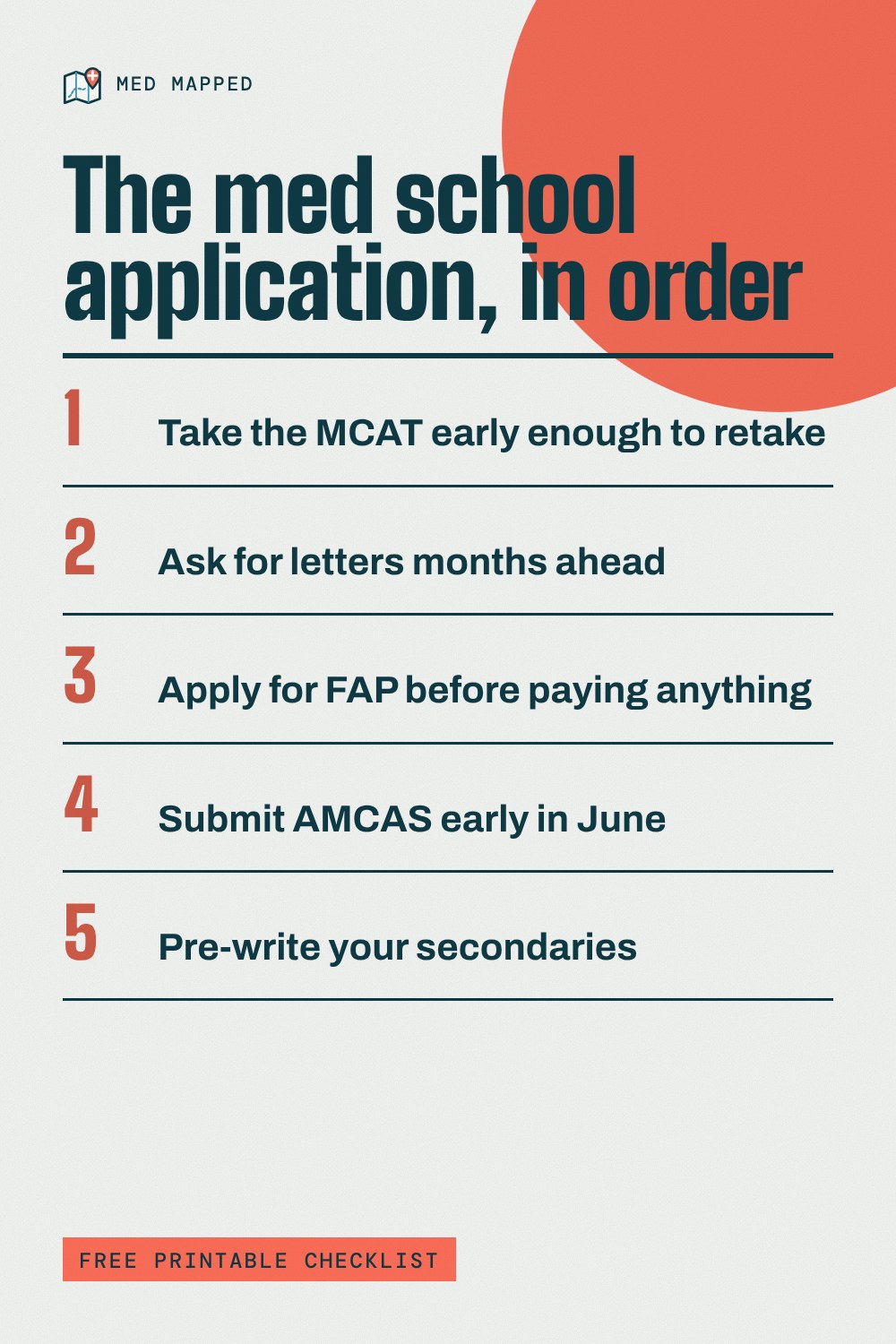
Take the MCAT early enough to retake it, ask for letters early, apply for FAP before paying for anything, submit AMCAS early in June, and pre-write your secondaries before they show up. If you do those five things, the rest of the timeline mostly takes care of itself. You've got this, and I'm rooting for you!