How to Pre-Write Med School Secondary Essays (Free Prompt-by-Prompt Plan)
Heads up: links to Med Mapped go to my own Etsy shop. I make a little if you buy, and the free printable here stays free either way.
The primary application gets all the attention, but secondaries are where the summer actually goes. Once your AMCAS application reaches schools, secondary invitations start arriving, sometimes several in the same week. Each one has its own prompts, its own limits and its own fee. If you're writing every essay from a blank page as it shows up, you fall behind fast.
The good news is that secondaries are more predictable than they look. Most schools ask some version of the same few questions every year. So the move is to draft one strong answer for each common prompt type before secondaries arrive, then adapt it for each school. Here's how I'd do it, prompt by prompt.
A few facts that shape the plan
- Most schools send a secondary to everyone. Dartmouth's health professions advising office, in its secondary guide for the 2025-26 cycle, says only a small handful of schools review your AMCAS application before deciding to send one. So expect a secondary from nearly every school on your list.
- Most schools charge a secondary fee. That same guide puts the average at around $100. In my cost of applying breakdown I used a range of free to about $150 per school. The exact fee for each school is listed in the AAMC's MSAR.
- Fee Assistance usually covers secondaries too. The AAMC says most AMCAS-participating schools waive their secondary fees for applicants granted Fee Assistance (FAP). If a school didn't waive yours automatically, ask its admissions office.
- "Two weeks" is a goal, not usually a rule. Many schools suggest turning secondaries around in about two weeks, but few set a hard deadline that short. A few do, so read each school's instructions the day the secondary arrives.
Fees and policies change every cycle, so confirm each one on the school's own page or in MSAR before you pay.
The prompt types to pre-write
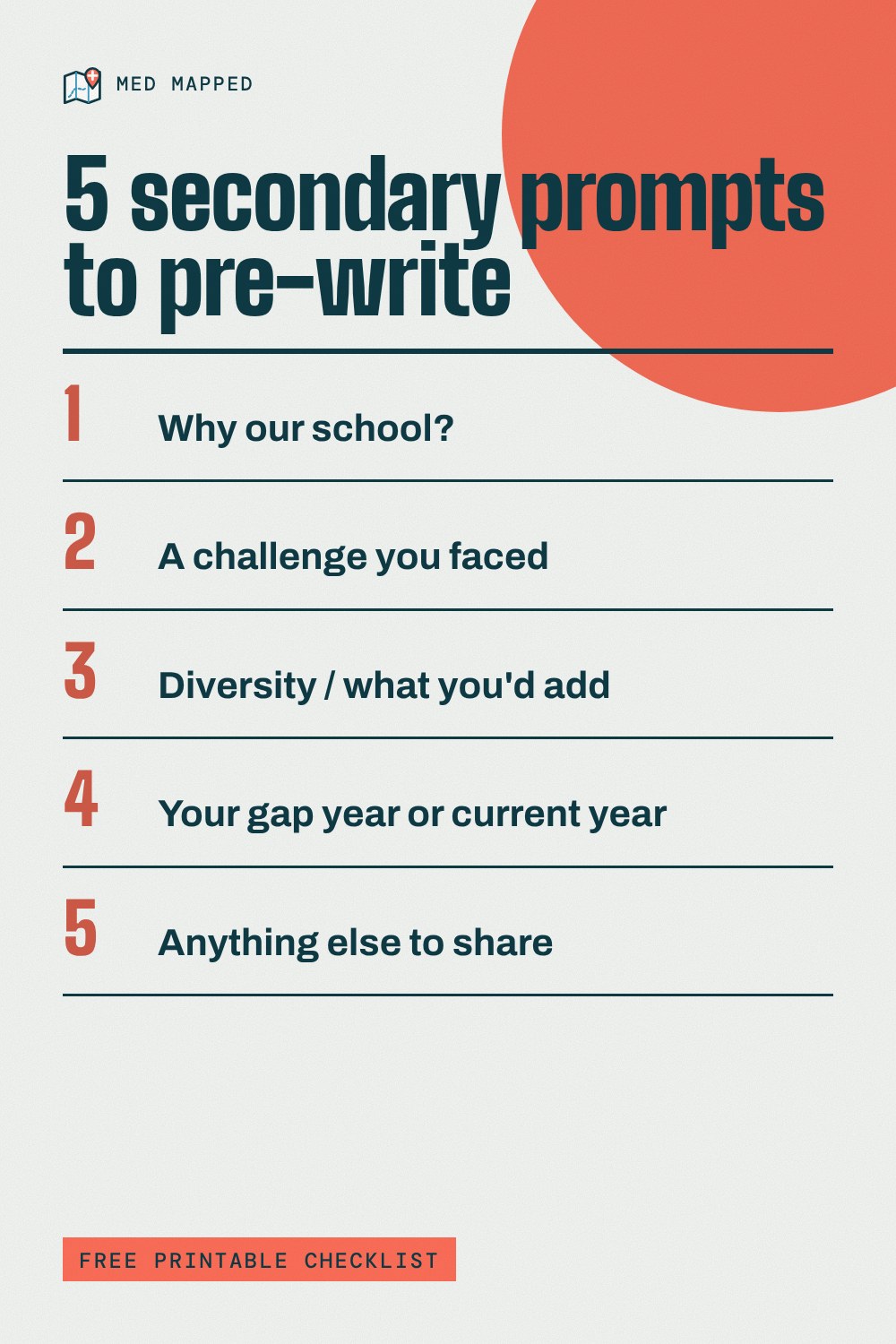
1. Why our school?
This is the most common prompt and the one people reuse badly. A "why us" essay that could be sent to any school reads like it was.
Pre-write the part that stays the same: what you want out of your training and the kind of doctor you're working toward. Then leave room for two specific details per school, like a clinic, a curriculum feature, a pathway or a patient population. Each detail should connect to something you've actually done. A line like "I want to work with your student-run free clinic because I spent two years at a free clinic at home" beats "your school has a strong commitment to service."
Do the school research when you build your list, not when the secondary arrives. Write two or three notes per school in your school list so the details are ready.
2. A challenge or setback
Pick one real difficulty. Not "I care too much," and not something you already told in full in your personal statement. Keep the setup short and spend most of your words on what you did about it and what changed in how you work now. Readers want to see how you respond when something goes wrong, which is most of what medicine is.
3. Diversity, or what you'd add to the class
Schools phrase this a lot of ways, but it's usually asking what you bring that's yours: your background, an identity, a skill, a community or an experience. The common mistake is listing traits. Choose one specific story, then say how it would shape the way you treat patients or work with classmates.
Limits for this prompt swing a lot between schools, so write a short version (around 100 words) and a long one (around 300) now. Cutting a long draft in half later takes longer than you think.
4. Your gap year, or what you're doing now
If you're not applying straight out of college, expect to be asked what you're doing this year. List each current role with its start date and hours, add a line on why you chose it, and use present tense for anything still going. Keep a running note of anything new since you submitted AMCAS, like a new role, a publication or more hours, because this prompt is a good place to mention it.
5. "Anything else you'd like us to know?"
This one is often optional. Use it if there's something the rest of your application doesn't explain: a semester where your grades dropped, a gap in your timeline, or a change of career path. Explain it plainly and briefly, without excuses. If there's nothing to address, a short update or leaving it blank is fine. Not every optional box needs an essay.
When secondaries start arriving
Pre-writing gets you most of the way. The rest is staying organized:
- Log each secondary the day it arrives: the school, the prompts, the limits, the fee and any deadline.
- Do the schools with stated deadlines first. Then work through the rest in order of how much you want to go there.
- Aim for about two weeks per school, but don't trade quality for speed. A realistic target is half done in the first two weeks and the rest in the two weeks after that.
- Keep everything in one place. One folder, one master draft per prompt type, and one copy of exactly what you sent to each school. You'll reread those before interviews.
If you'd rather track all of that in a spreadsheet, with every school's secondary status, fee and deadline next to the rest of your application, that's what my med school tracker is built for:
The final check before you hit submit
Most secondary mistakes are small and avoidable. Before each one:
- Answer exactly what they asked. Reused drafts drift. If the prompt asks about a challenge on a team, the story has to be about a team.
- Search the draft for every other school's name. Sending one school an essay that praises another is the classic copy-paste error, and it's easy to catch with a quick search.
- Check the limit in the school's own form, since some count characters and some count words.
- Confirm the fee was paid or waived.
- Save a copy of what you submitted. Interviewers often have your secondary in front of them.
How to use the printable
Page one has a short checklist for the four big prompt types, so you can work through your drafts in May and June. Page two starts with the optional "anything else" prompt, then covers what to do before secondaries show up, a turnaround plan for when they do, and the final check above. Print both, keep them next to your drafts, and tick things off as you go.
If you're still mapping out the full cycle, the month-by-month application timeline shows where secondaries fit between AMCAS and interviews.
The short version
Draft the five common prompt types before secondaries arrive, keep a long and a short version of each, research each school's details when you build your list, and do a name search before every submit. That turns a summer of blank pages into a summer of editing.