A Weekly Study Schedule for Med School (Free Printable Planner)
Heads up: links to Med Mapped go to my own Etsy shop. I make a little if you buy, and the free printable here stays free either way.
The first thing that surprises most people about med school isn't how hard any one topic is. It's the volume. A week of lectures can cover what a semester of undergrad did, and the next week starts before you've finished reviewing the last one. The students who stay afloat usually aren't studying more hours than everyone else. They have a schedule that decides ahead of time when new material gets learned, when it gets reviewed, and when they stop for the day. And that's something anyone can build!
This post walks through how to build that kind of week, plus a free printable planner to sketch it out. Every school's calendar is different, so think of it as a friendly framework you fill in with your own lectures, labs and exams.
Start with what's fixed
Before you plan any studying, block out everything you can't move:
- Required sessions: small groups, labs, clinical skills, anything with attendance.
- Exams and quizzes for the whole block, so you can see the crunch weeks coming.
- Sleep. Pick a bedtime and treat it like a required session. Memory consolidation happens during sleep, and a schedule that only works on five hours a night doesn't work.
- One thing that isn't medicine. A workout, a call home, a weekly dinner. If it isn't on the schedule, it's the first thing to go, and you deserve to keep it!
Whatever's left is your study time. It's usually less than you'd guess, which is exactly why it needs a plan.
The daily loop: new material, then review
Two study methods have the strongest research behind them: practice testing (making yourself recall the answer) and spaced practice (reviewing over days instead of all at once). A large 2013 review of learning techniques by Dunlosky and colleagues rated those two as the most useful of the ten methods it compared. Rereading and highlighting came out near the bottom. (Sorry, highlighters!)
That's why so many med students build their day around flashcards with a spaced-repetition app like Anki, often using a shared deck such as AnKing alongside their own lecture cards. A simple daily loop looks like this:
- Review first. Do your due flashcards before anything new, while you're fresh. Missing a day makes the next day's pile bigger.
- Learn today's material. Go through the day's lectures. Skip making pretty notes; spend the time on understanding the mechanism.
- Make or unsuspend cards for today's lectures so tomorrow's review includes them.
- Stop at a set time. An end time is what keeps this sustainable for a whole block. Rest is part of the plan!
The weekly shape
Most weeks follow a rhythm once you see it. A template that works for a lot of students:
| Day | Focus |
|---|---|
| Monday to Thursday | Daily loop: reviews, new lectures, cards |
| Friday | Daily loop, plus catch up on anything you fell behind on |
| Saturday | Practice questions on the week's material, then a real break! |
| Sunday | Light reviews, plan next week, prep anything due Monday |
The Saturday question block matters. Flashcards check whether you remember a fact; practice questions check whether you can use it. Doing questions every week also shows you your weak topics while there's still time to fix them before the exam. That's a win!
Exam weeks
In the last week or two before a block exam, shift the balance: fewer new cards, more practice questions, and a review pass through the topics you keep missing. Don't stop your daily reviews entirely, or you'll come back to a mountain after the exam.
How to use the printable
The planner has two pages:
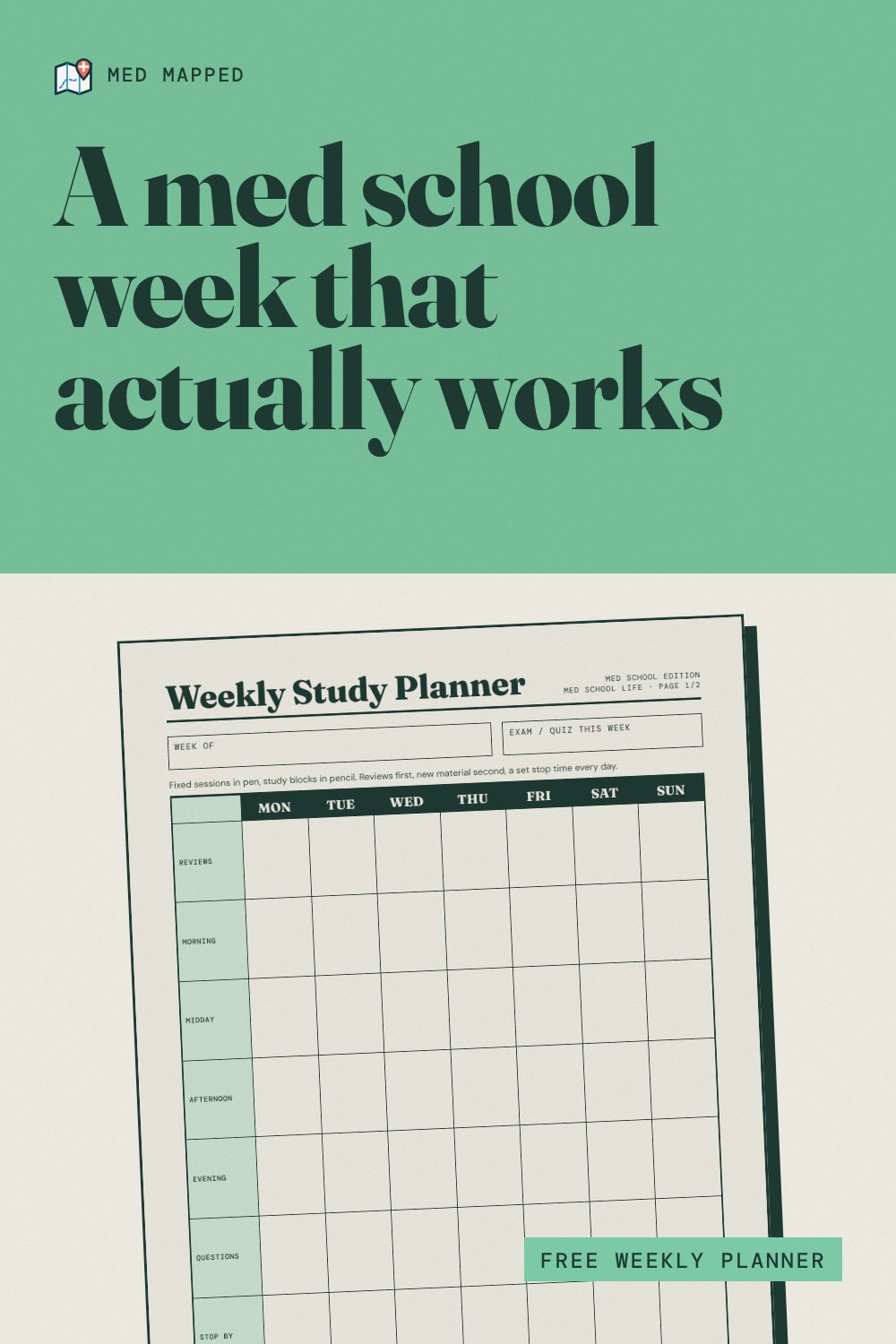
- Page 1, the weekly grid: seven days, split into morning, midday, afternoon and evening blocks, plus a row for your daily review goal. Fill in the fixed stuff in pen and your study blocks in pencil.
- Page 2, the week's plan: this week's lectures and exams, your weak topics from practice questions, and a short check-in for the end of the week (what worked, what to change).
Print a fresh copy each Sunday. After two or three weeks you'll know what your realistic week actually looks like, and planning gets so much faster!
A few honest notes
- Your first schedule will be wrong. That's completely fine! Adjust it every Sunday based on what actually happened.
- Don't copy someone else's hours. Some classmates will study twelve hours a day and some will study six. What matters is whether your reviews are getting done and your question scores are going up.
- Ask for help early. Every school has learning specialists and upperclassmen who've been through the same block. Using them is normal, not a sign you're behind. Be kind to yourself out there!
Still applying? Start with the month-by-month med school application timeline, or see what applying actually costs.