My Non-Traditional Path to Med School (and How to Map Your Own Story)
Heads up: links to Med Mapped go to my own Etsy shop. I make a little if you buy, and the free printable here stays free either way.
I didn't start college as a premed. I studied piano performance at the University of Oregon, with a chemistry minor on the side. If you had told freshman me that I'd end up in med school, I probably would have laughed and gone back to the practice room!
So if your path looks a little "off the map" right now, hi, I get it. A lot of us worry that a winding road reads as a weakness. Here's what I've learned since then: a non-traditional path isn't something to hide. It's usually the most interesting part of your application, as long as you can show how the pieces connect. This post walks through what counts, how to tell the story, and a one-page worksheet to map your own path before you write a single word.
My path, the short version
Here's mine, honestly, with all the turns left in:
- Piano performance at Oregon, plus a chemistry minor. I still perform and compete, so music never really left!
- Ophthalmic technician after college. This is where I first saw clinic from the inside: real patients, real workflows, and what a physician's day actually looks like.
- Research I didn't plan on. That job pulled me into research, and I ended up co-authoring a neuro-ophthalmology case report.
- Two entrance exams. I took the DAT and was accepted to dental school before I realized medicine was where I belonged. Then I took the MCAT too.
- I applied in the 2025-2026 cycle, and now I'm a first-year at Brown's Warren Alpert Medical School.
None of that was a straight line, and I'm not going to pretend I had it all figured out. I didn't! But every chapter ended up mattering, which is the whole point of this post.
What actually counts (more than you think)
When applicants on student forums ask whether their background "counts," the replies people agree with tend to land in the same places. Here's my take on them:
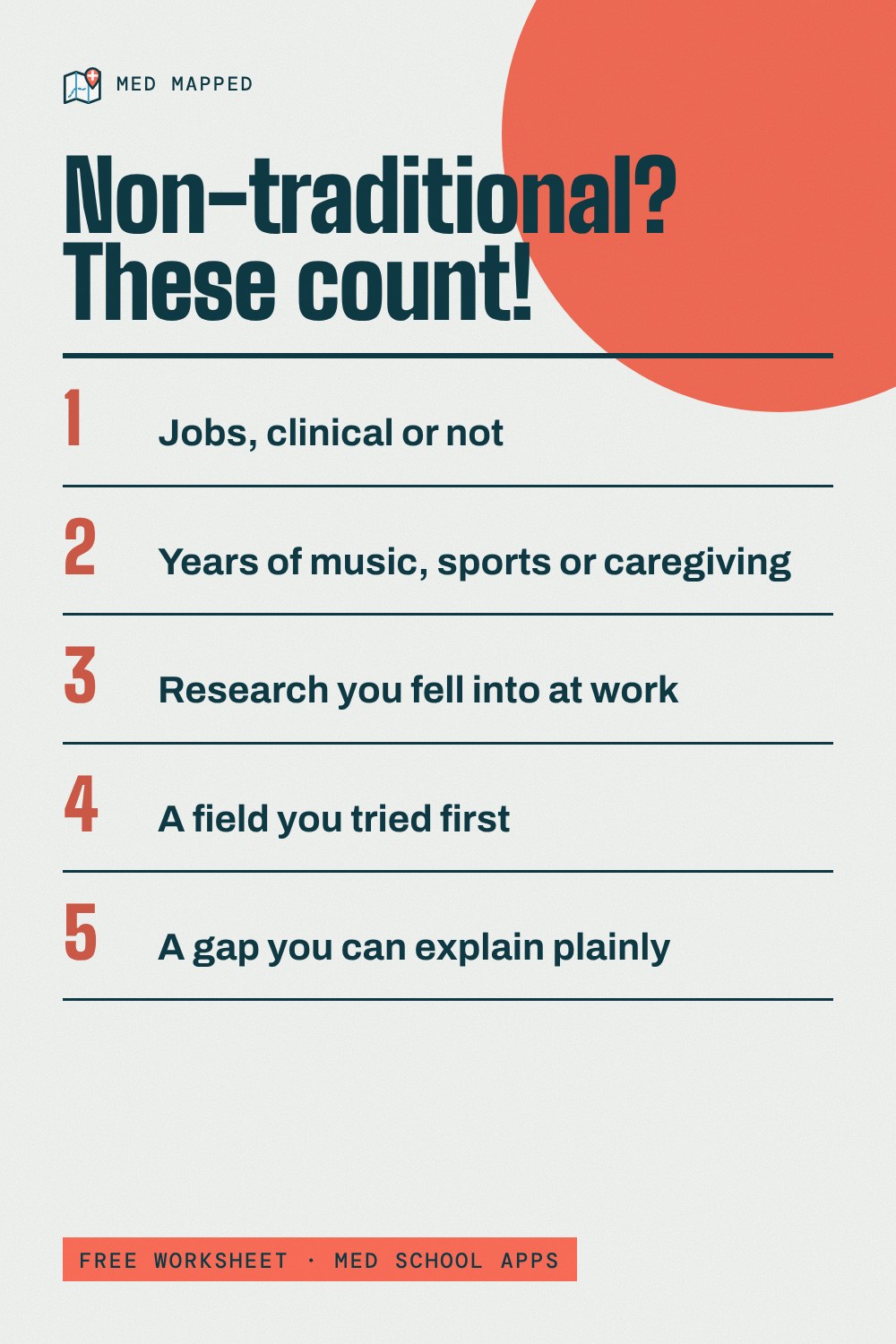
- Jobs count. A paid job is a real experience on your application, not filler. A clinical job like scribe, tech or assistant shows you've seen medicine up close for a long stretch. A non-clinical job still shows responsibility, reliability and working with people.
- Long commitments count. Years of an instrument, a sport, caregiving for a family member or teaching all show you can stick with something hard. Depth beats a long list!
- Unplanned things count. Research you fell into at work, a skill you picked up on the job, a role you grew into. You don't need to have planned it for it to matter.
- Changing your mind counts too. A forum tip I've seen others agree with: frame your earlier path as something you genuinely tried, not a failed plan. Trying something seriously and learning it wasn't your place is a mature thing to do.
One caution that also comes up a lot: if you seriously considered a neighboring field (dentistry, PA, nursing, research, music therapy, anything), expect to be asked "why not that?" Have a clear, honest answer ready. Not a dig at the other field, just what medicine gives you that it doesn't.
How AMCAS fits a winding path
The application has more room for a non-traditional story than people expect. In the AAMC's opening webinar for the 2027 AMCAS cycle, they listed these Work and Activities rules:
- Up to 15 entries, and up to 3 can be marked "most meaningful."
- Repeated activities can get extra date ranges, so a job you left and came back to can stay one entry.
- You can add anticipated hours for something you're still doing, as late as August 2027.
The AAMC also updated the "Social Justice/Advocacy" experience type to "Community Health Advocacy" for 2027. Rules shift a little every cycle, so check the current AMCAS Applicant Guide before you start filling things in.
My advice: pick your three "most meaningful" by which experiences best show the thread to medicine, not by which sound most impressive. For a lot of non-trads, the job that pulled you toward medicine is an obvious one.
Telling your story without apologizing for it
This is the part I'd spend the most time on. A few things that help:
- Find the thread, not the pivot. List your chapters, then write down what each one gave you. Often the skills you'd never connect to medicine (discipline, performing under pressure, listening closely) are exactly what make the story make sense.
- Use a simple arc. When did medicine first show up? What made it grow? When did you commit, and why then? Three beats is enough for a personal statement to feel clear.
- Show, don't announce. "Music taught me discipline" is a claim. One specific moment where you saw it happen is a story!
- Explain gaps plainly. A gap year, a grade dip or a career change just needs a short, honest explanation. No excuses and no long apology.
- Think about letters early. Supervisors and mentors who watched you work can speak to things a professor can't, but schools have different letter rules. Check each school's requirements in MSAR, and ask early, because busy supervisors need time.
And please, don't compare your timeline to the 22-year-old who did everything "in order." Different roads, same destination. You're allowed to take the scenic route!
Keeping all the pieces organized
The hardest practical part of a non-traditional application is that your experiences are spread across years, jobs and sometimes different schools. Dates, hours and contacts get fuzzy fast. If you'd like one place to keep them, plus your school list, fees and secondaries, my med school tracker is built for exactly that:
Also, AMCAS asks for transcripts from every college you attended, including community college or a post-bacc. Request those early, since they can take longer than you'd think.
How to use the worksheet
Print the one-page worksheet and fill it in before you draft anything. Start with your chapters and what each one gave you. Then fill in the thread to medicine, turn it into a short list of experiences and letter writers, and finish with three questions to practice out loud. Non-trads often get asked "why now?", so it's worth hearing yourself answer it a few times!
If you're also figuring out when everything happens, the month-by-month application timeline lays out the whole cycle. And when secondaries ask about your gap year or current job, my secondary essay pre-writing plan has you covered.
The short version
Your path counts. Jobs, long commitments and changes of direction are all real experiences. Map your chapters, find the thread that runs through them, have an honest answer for "why medicine and not the field next door," and explain any gaps plainly. Your winding road might be the most memorable part of your application. You've got this!