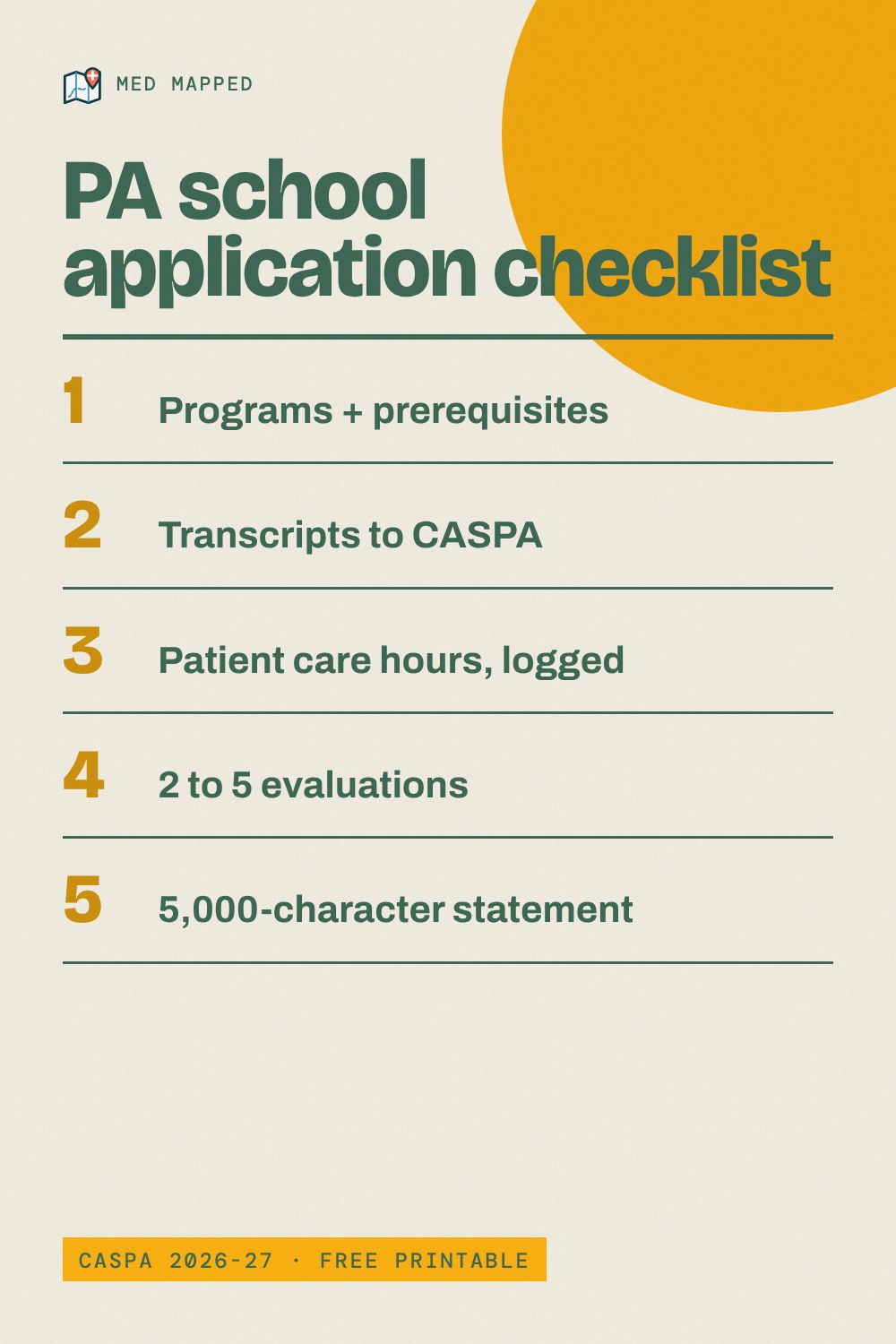
PA School Application Checklist: CASPA Step by Step (Free Printable)
Heads up: links to Med Mapped go to my own Etsy shop. I make a little if you buy, and the free printable here stays free either way.
Applying to PA school looks simpler than applying to med school, and in some ways it is! CASPA is one portal, one essay and one fee schedule, but it has its own rules about hours, evaluations and verification that trip people up every cycle. I'm on the MD side, so for everything below I went straight to CASPA's own help center for the 2026-27 cycle rather than going from memory.
Here's the whole thing in the order I'd actually do it, plus a free two-page checklist so nothing slips. Let's get you organized!
The numbers for the 2026-27 cycle
These come from the CASPA Applicant Help Center (run by Liaison, the company behind CASPA) for the 2026-27 cycle:
- CASPA opened April 30, 2026. The cycle runs into April 2027, but that end date is not your deadline. Every program sets its own, and you can check each one in CASPA under Add Program.
- Fees are $185 for your first program and $65 for each additional one. Some programs also charge their own supplemental fee on top.
- The personal statement has a 5,000-character limit, and CASPA counts spaces, line breaks and punctuation.
- You need at least 2 evaluations and can send up to 5 through CASPA.
- Verification can take up to 10 business days once everything has arrived.
Fees and dates change every cycle, so confirm them on CASPA's site and each program's page before you pay anything.
What CASPA will cost you
Since the fee is $185 plus $65 per extra program, here's how it adds up before any supplemental fees:
| Programs | CASPA fees |
|---|---|
| 5 | $445 |
| 10 | $770 |
| 15 | $1,095 |
| 20 | $1,420 |
Then add supplemental fees, any required test and interview travel. It adds up fast, so build your program list with a budget in mind from the start!
About fee waivers: CASPA's fee waiver covers your first two programs ($250 total), and waivers are limited and first-come, first-served. For 2026-27, CASPA says it stopped accepting waiver requests in September 2026. If you're applying next cycle, look at the fee waiver page as soon as the new cycle opens, and request it before you submit, because CASPA won't honor a request made after you've submitted.
Step 1: Build your program list (start here)
PA programs vary a lot more than people expect. Before you write a word, make a list with these for every program:
- The deadline, and whether it reviews on a rolling basis. On a rolling program, a seat can be gone before the deadline, so earlier really is better.
- Prerequisites. Compare each one against your actual transcript, course by course.
- Minimum hours and what kind count. Some want a set number of patient care hours, some want shadowing with a PA specifically.
- Tests. Some programs want the GRE or the PA-CAT, and some want neither.
- Supplemental applications and fees.
This is the boring part, but it's the part that saves you from paying to apply somewhere you don't qualify for yet. Future you will thank you!
Step 2: Transcripts and coursework
CASPA wants official transcripts from every college you've attended, including community college or dual-enrollment schools whose credits transferred to your main school. Order them early, because CASPA can't verify anything until they arrive.
Then you enter your US coursework by hand in Transcript Entry, matching the transcript exactly. This is where verification problems come from: a typo in a grade or a course number can bounce your application back to you. Take your time here and do it with the transcript open next to you.
Step 3: Experiences and hours
This is the section that makes PA applications different from MD, so it deserves real care. CASPA sorts experiences into types, and the two big ones are easy to mix up:
- Patient Care Experience: you're directly responsible for a patient's care. CASPA's examples include EMTs, paramedics, nurses and phlebotomists.
- Healthcare Experience: paid or unpaid work in a health setting where you're not directly responsible for the patient's care, even if you interact with patients, like a scribe.
There are also separate types for shadowing, research, volunteering, leadership, teaching and non-healthcare jobs. A few rules from CASPA that matter:
- Don't count the same hours twice. If one job really spans two types, split the hours and duties between them.
- Use the average weekly hours you actually worked, not what you planned to work.
- Every entry needs a supervisor contact so programs can verify it.
My biggest tip: keep a running log from your very first shift, with dates, hours and your supervisor's name. Rebuilding two years of hours from memory in April is miserable. Start the log today, even if you're a year out!
Step 4: Evaluations
Ask for at least two, and up to five. Check what each program wants first, since some ask for one from a PA or another clinician. Ask early, give your evaluators your resume and a short note on what you'd love them to speak to, and send a polite reminder a couple of weeks before you plan to submit.
One small thing that catches people: the waiver of your right to view each evaluation can't be changed once you pick an answer, so decide before you send the request.
Step 5: The personal statement
The prompt is simple: why do you want to be a PA? The trap is answering "why medicine" instead. Programs want to know why this role, so tie your answer to things you've actually seen and done, like a PA you shadowed or a moment in your patient care job.
Remember the 5,000-character limit counts spaces. And once you submit, the essay can't be edited, so get one trusted reader and do a slow final proofread out loud. You can do this!
Step 6: Submit, then watch verification
CASPA's own suggested timeline is to submit at least 6-8 weeks before your program deadlines. Before you hit submit:
- Add every program you're applying to.
- Pay CASPA and any program fees.
- Save a PDF of the whole application. You'll want it before interviews!
You can submit before every transcript and evaluation has arrived. Your status turns Complete once the required materials are in, and then verification can take up to 10 business days. Check your status every few days. If a transcript is missing or your application comes back Undelivered, fix it right away, because the clock on rolling programs keeps ticking.
Step 7: After you submit
- Send each program's supplemental, if it has one.
- Keep logging hours. New experience is great material for interviews.
- Reread your application before every interview, since interviewers often have it in front of them.
- Track every program's status in one place, so you always know who's waiting on what.
How to use the printable
Page one covers everything before you submit: your program list, transcripts, experiences and evaluations. Page two covers the personal statement, submitting, verification and what to do after. Print both, stick them next to your laptop and check things off as you go. Little wins add up!
If you're weighing PA against MD, my breakdown of what it costs to apply to med school shows how AMCAS fees compare, and the month-by-month med school application timeline is a good picture of how the two cycles differ in shape.
The short version
Build your program list first, order every transcript, log your hours by type with a supervisor for each, line up 2 to 5 evaluations, keep your statement under 5,000 characters and submit 6-8 weeks before your deadlines. Then watch your status until it says Verified. You're going to do great!