A 3-Month MCAT Study Schedule (Free 12-Week Printable Plan)
Heads up: links to Med Mapped go to my own Etsy shop. I make a little if you buy, and the free printable here stays free either way.
Starting MCAT prep can feel like standing at the bottom of a really tall mountain. There's so much content, a dozen prep companies all telling you their way is the only way, and a test that runs most of a day. If you're overwhelmed, that's honestly the most normal feeling in premed!
I've taken the MCAT myself, so I know that feeling well. Here's how I'd lay out three months if a friend asked me, built on the advice that keeps coming up from people who've been through it on r/MCAT and student forums. There's a free 12-week printable plan with a score log at the end, too.
First, know what you're training for
Per the AAMC's "What's on the MCAT Exam?" guide for the 2027 testing year, the exam has four sections:
| Section | Questions | Time |
|---|---|---|
| Chemical and Physical Foundations of Biological Systems | 59 | 95 min |
| Critical Analysis and Reasoning Skills (CARS) | 53 | 90 min |
| Biological and Biochemical Foundations of Living Systems | 59 | 95 min |
| Psychological, Social, and Biological Foundations of Behavior | 59 | 95 min |
That's 6 hours and 15 minutes of content and about 7 and a half hours of seated time, not counting check-in. So part of what you're building over three months is plain stamina. Always confirm the current format, dates and policies on the AAMC's site before you register, since they can change from year to year.
Is three months enough?
For a lot of people, yes, especially if you can study close to full time or your science courses are recent. If you're working, taking a full course load, or it's been a while since biochem, many students stretch the same plan over four to six months. Neither is better! The right length is the one that fits your actual life. Pick a test date that leaves room for a bad week, because there will be one.
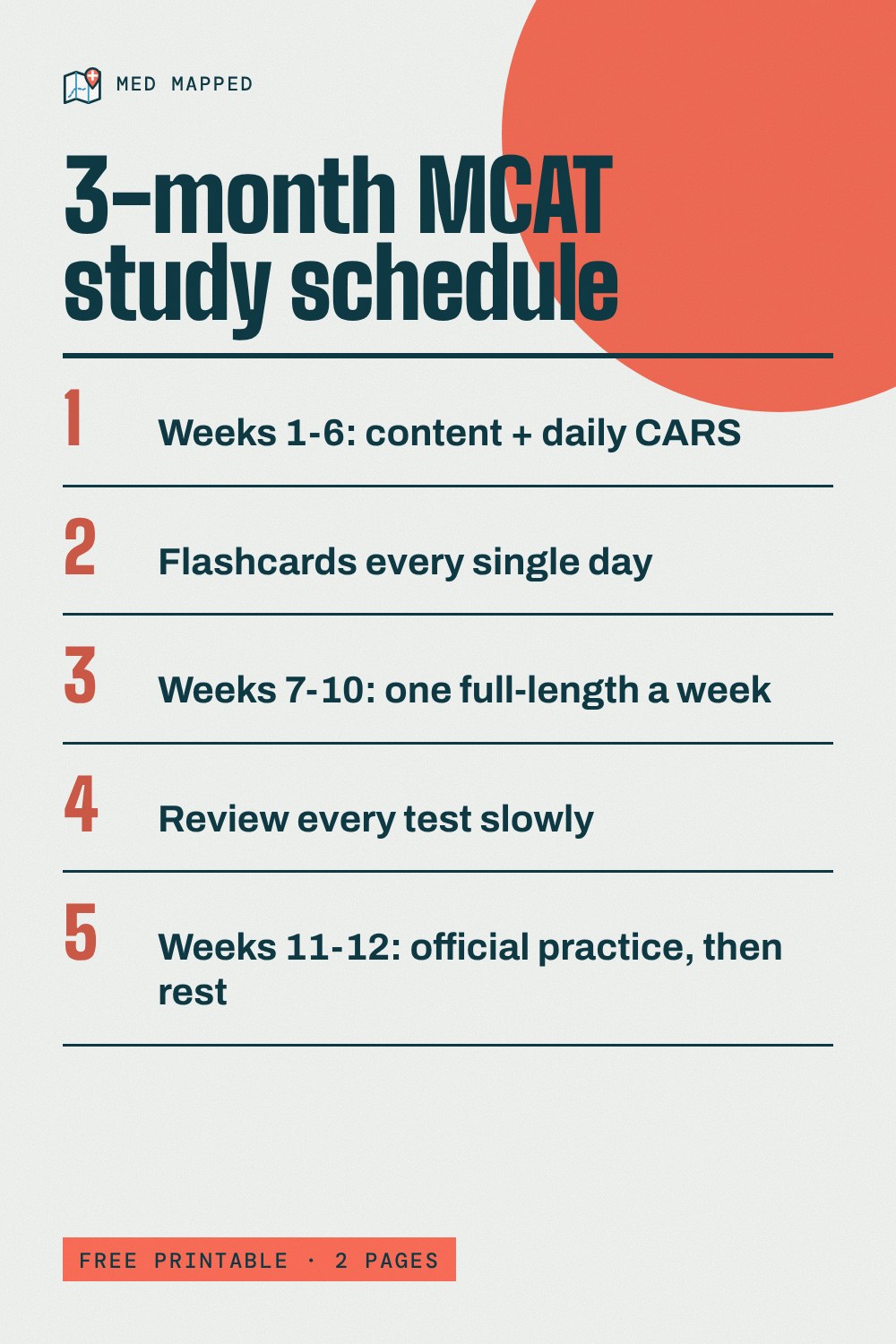
Weeks 1 to 6: content, plus a little every day
The first half is about building the base, without losing touch with the test format.
- Content review by topic. Work through one subject area at a time with whatever review books or videos you've picked. One set of resources, used well, beats four sets half-finished.
- Flashcards daily. Lots of students make or use a shared Anki deck for content review. Do your reviews every day, even on busy days, so things stick.
- CARS every day. Two or three passages a day is a common recommendation. CARS improves slowly, so starting early really helps.
- Questions on what you just reviewed. A handful of practice questions after each topic shows you right away whether it actually landed.
Before week 1, a lot of people take one diagnostic test just to see where they are. Please don't panic about that score! It's a starting line, not a prediction.
Weeks 7 to 10: practice becomes the main event
Now flip the balance. Content review shrinks to your weak spots, and practice takes over.
- One full-length a week, taken under real conditions: same start time as your test, timed sections, real breaks.
- Review every full-length slowly. This is the advice I see repeated most often. The review is where the points come from. Go through every missed question and every lucky guess, and write down why the right answer is right. Give the review at least as long as the test took.
- Turn misses into next week's plan. Your score log tells you exactly what to study, which is honestly kind of a relief!
Weeks 11 and 12: official practice, review, rest
The AAMC sells official prep materials, including practice exams and a section bank, and they're also part of the AAMC Fee Assistance Program for people who qualify. A really common tip from people who've taken the test is to save the official full-lengths for the last stretch, since they're written by the people who write the exam. Many also say the section bank is worth going through slowly, with careful review of the reasoning behind each answer.
The final week, ease off. No new content, light review, one practice run of your test-day routine, and real sleep. Cramming in the last 48 hours tends to cost more than it gains.
Things that make a schedule actually work
- Schedule study blocks like appointments. Same times each day when you can.
- Take one real day off each week. Burnout is the fastest way to lose a whole week.
- Track your scores in one place. Watching the trend over several full-lengths is far more useful than staring at any single score.
- Don't compare your timeline to strangers online. People post their best weeks. Your plan only has to work for you.
If you're planning your MCAT alongside the rest of your application, my med school tracker keeps your test dates, school list and deadlines in one spreadsheet:
How to use the printable
Page one is a 12-week grid. Write each week's focus, the content you're covering, your practice question goals, your full-length (if it's a test week) and a quick note on wins and misses. Page two has a before-week-1 checklist, a full-length score log, a review checklist for after every practice test, and a test-week list.
Thinking about the whole timeline? The month-by-month med school application timeline shows where the MCAT fits, and what applying costs covers the registration and Fee Assistance details.
The short version
Know the format, pick a timeline that fits your real life, build content in the first half while doing a little CARS every day, then let practice take over with one full-length a week and slow, honest reviews. Save the official practice for the end, rest before test day, and be kind to yourself through the hard weeks. You've totally got this!