How to Prep for Med School Interviews (Traditional and MMI) + a Free Checklist
Heads up: links to Med Mapped go to my own Etsy shop. I make a little if you buy, and the free printable here stays free either way.
If an interview invite just landed in your inbox, first of all: congratulations! Seriously, take a second to enjoy it. A school read your whole application and said "we want to meet you." That's a big deal.
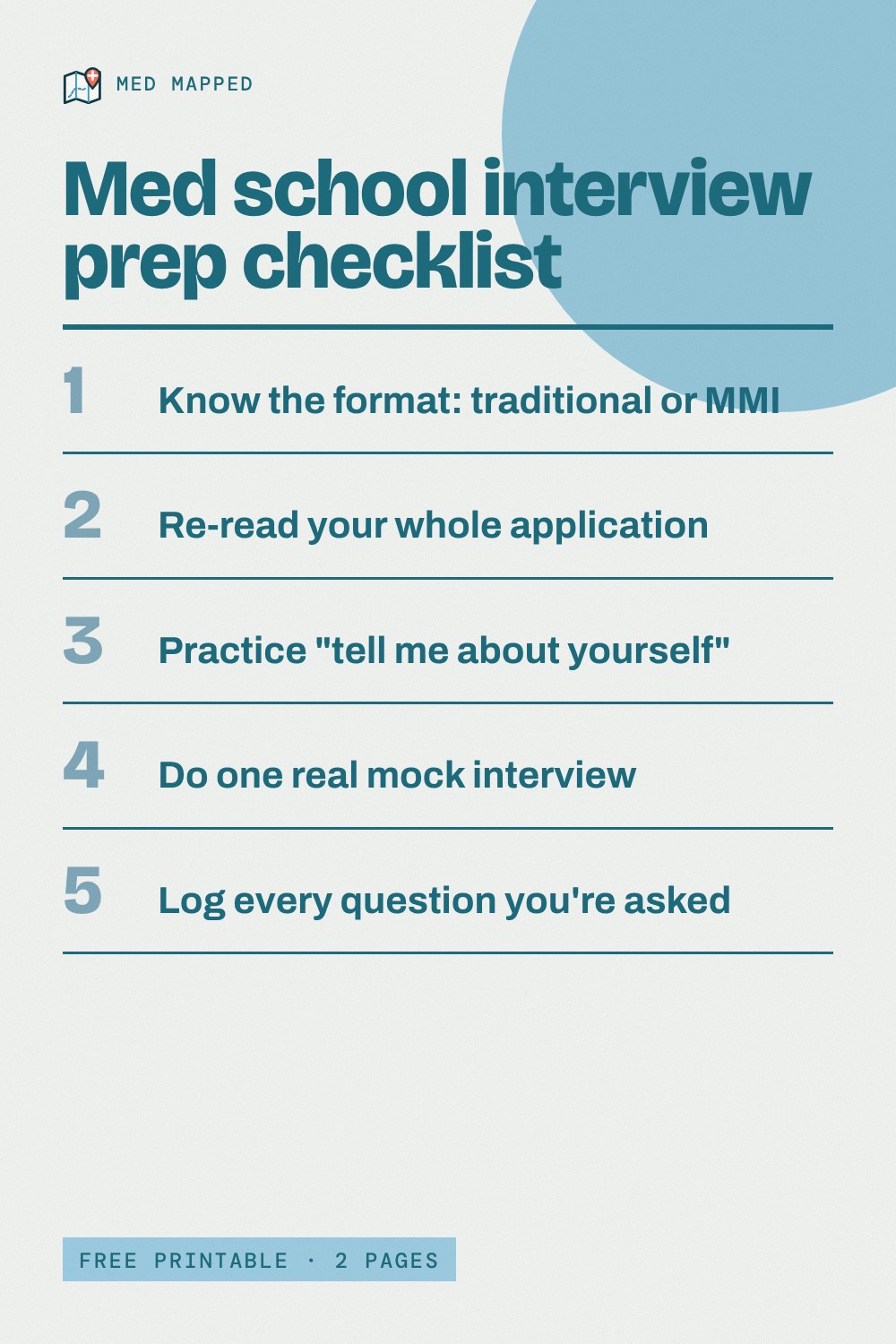
Then the nerves usually show up. What format is it? What will they ask? What do I even wear on a Zoom call? It can feel like everyone else got a secret playbook. They didn't! Interview prep is mostly a handful of simple, boring-in-a-good-way steps, done early and out loud. Here's how I'd walk a friend through it, plus a free two-page checklist with a question log for the day itself.
First, figure out which format you're walking into
Med schools don't all interview the same way, and the prep is a little different for each. The big ones:
- Traditional (one-on-one). A conversation with a faculty member, student or admissions person, usually about you and your application. Some are "open file" (they've read your application) and some are "closed file" (they know little beyond your name), so the invite or the school's site is worth checking.
- Panel. Same idea, but with a few interviewers at once.
- MMI (multiple mini interview). The AAMC describes it as a series of 6-10 stations, each built around a different question or scenario, with a two-minute prep period and then a conversation of five to eight minutes. Stations can be ethical dilemmas, teamwork tasks or role-plays, and the AAMC says the MMI doesn't test specific knowledge. It's about how you think and communicate.
Plenty of schools mix formats, and many interview virtually. Your invite email is the final word for each school. To compare your whole list at a glance, the AAMC publishes an interview policies report through MSAR. Trust the school over anything online, including this post!
Know the school beyond its website
AAMC admissions officers suggest not relying on a school's website alone, and I think that's the most underrated tip out there. Everyone reads the homepage. Fewer people can say something real about the community the school serves and what health challenges that community faces.
For each school, I'd write down three things: the mission in your own words, two or three things that are actually specific to that school (a curriculum feature, a clinic, a program), and the honest reason you'd be happy there. If your "why this school" answer could be pasted into any other school's interview, keep digging. It's okay if this takes a few tries!
Know your own application cold
This sounds obvious, but it's easy to skip. Your application might have been submitted months ago, and the interviewer may have it open in front of them. The AAMC's advice is to review it before the interview, and I'd go a step further: re-read your personal statement, your Work and Activities and that school's secondary essays the night before. Anything you wrote is fair game.
If there's a weak spot (a rough semester, a gap, an MCAT retake), have a short, honest answer ready. Admissions officers say to answer it if you're asked and explain what you learned, but you don't need to bring it up yourself. A calm two sentences beats a nervous five-minute explanation every time.
Practice out loud (this is the whole game)
Here's the tip that comes up again and again in well-liked premed threads: practice out loud, not just in your head. An answer that sounds great in your head can come out as a ten-minute ramble the first time you say it. The second and third time it gets so much better!
The questions I'd practice first:
- Tell me about yourself. Aim for about two minutes. It's not a resume recital; pick the few things that explain who you are and why you're in the room.
- Why medicine? The AAMC's admissions officers frame it as your journey: what sparked it, what experiences deepened it, and what kind of physician you hope to become. "I want to help people" is true for all of us, so go past it.
- A time you worked on a team, and a challenge or mistake. Have one real story for each, with what you actually did and what you'd do differently.
- Why not a neighboring field? If you spent real time near nursing, PA, dentistry or research, expect it. Be honest and kind to the other field.
A few more tips people keep confirming on Reddit and student forums:
- Bullet points, not scripts. Memorized paragraphs sound memorized. Know your three key points and let the words be different each time.
- Answer the question they asked. An interviewer on r/premed once said a surprising number of applicants drift into a prepared answer for a different question. Listen to the whole prompt first. The AAMC also says it's fine to pause and think before you answer!
- For MMI, use your time. Practice on a timer with the short read, then talk. If you get stuck on an ethics station, walk through your thinking out loud and consider the different people involved before you land on a decision.
- Do at least one real mock interview. A friend, your premed advisor or a career center. Being watched changes everything, and it's way better to discover your nervous habit in a practice room.
Virtual or in person: little things that help
If your interview is virtual, test your camera, mic and internet the day before, sit with light in front of you (not a window behind you), and save the link plus a backup phone number. Turn notifications off. Looking at the camera instead of the faces on screen feels weird, but it reads as eye contact!
If it's in person, plan the route and parking, try on the outfit the night before, and bring water and your questions to ask. And be kind to everyone you meet that day, from the front desk to the student tour guide. You might be meeting future classmates!
Bring good questions (and write down theirs)
The questions you ask are a chance to learn whether the school fits you, not just a box to check. The AAMC's officers suggest even a simple one like "What's your favorite thing about this school?" if you're stuck. I'd also ask current students about support, schedules and what they wish they'd known.
Then, the same day, fill in the question log on page two: who you met, one thing you talked about with each person, the questions you were asked and your gut feeling about fit. When you're comparing schools in the spring, these notes are gold. If the school's policy allows thank-you notes, those notes make them easy to write too.
If you're juggling a bunch of invites, my med school tracker keeps your schools, interview dates and decisions all in one spreadsheet:
How to use the printable
Page one is your before-the-day checklist: format, school research, your application and the questions to practice. Print one per school and check things off as you go. Page two is for the day itself, with virtual and in-person setup lists, the question log and a "right after" list.
Earlier in the cycle? The secondary essay pre-writing plan gets your "why this school" thinking started, and if you're a non-trad, mapping your path is great practice for "tell me about yourself."
The short version
Find out the format for each school, learn what makes each one different, re-read your own application, and practice the big questions out loud until they feel like a conversation. Log everything the same day. And remember, they invited you because they already like what they've read. Now you just get to be yourself in the room. You've got this!