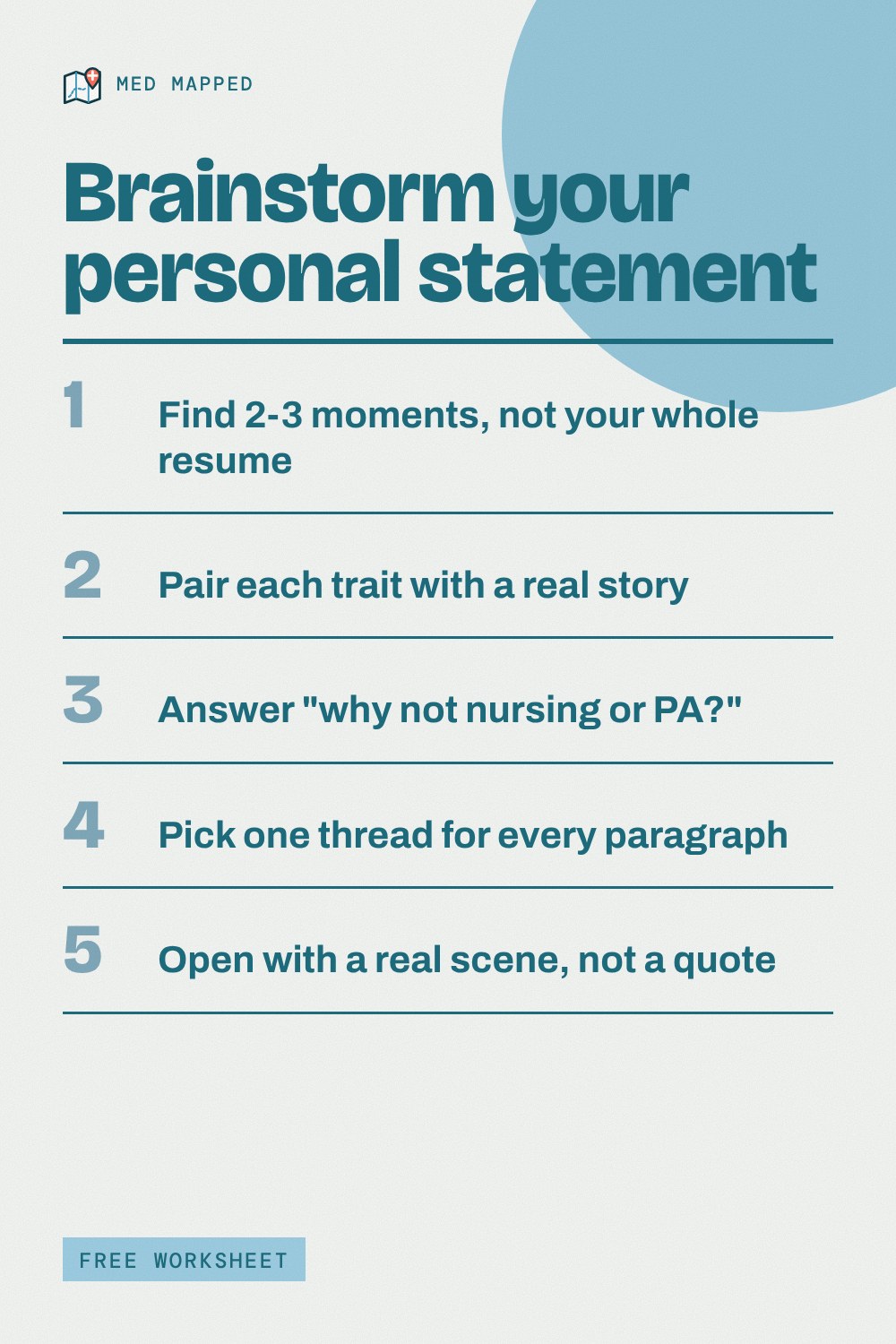
How to Brainstorm Your Med School Personal Statement (+ a Free Worksheet)
Heads up: links to Med Mapped go to my own Etsy shop. I make a little if you buy, and the free printable here stays free either way.
The blank page is the worst part of the personal statement. You open a doc, type "Ever since I was young," delete it, and then stare at the cursor for twenty minutes. If that's been you, you're in very good company!
I wrote one during the 2025-2026 cycle, and my own path ran through piano performance, a job as an ophthalmic technician and even a dental school acceptance before I landed on medicine. So I get the feeling of looking at a pile of experiences and wondering which ones belong on one page. Here's how I'd brainstorm it if a friend asked, built on the tips that keep getting confirmed in well-liked r/premed threads and advising guides. There's a free one-page worksheet at the end.
First, know the box you're writing in
Per the AAMC's 2027 AMCAS Applicant Guide, the Personal Comments Essay gets 5,300 characters, including spaces. That's about one page. A few other details from the guide are worth knowing before you start:
- Schools receive it as plain text, so formatting like bold or italics won't carry over.
- The same essay goes to every medical school on your list.
- You can't change it after you submit, not even a typo.
The guide also lists questions you might consider: why you've selected the field of medicine, what motivates you to learn more about it, and what you want schools to know that isn't covered elsewhere in your application. Check the AAMC's current guide for your own cycle before you finalize anything, since details can change from year to year.
Here's the big takeaway from that number. 5,300 characters is roughly 800 to 900 words. That's room for two or three moments told well, not your whole resume. Your activities section already does the listing. The personal statement does the meaning!
Step 1: Collect moments, not achievements
The most repeated brainstorming advice is to start with moments instead of accomplishments. Grab a notebook and jot down quick notes (not sentences!) for things like:
- A moment with someone you were helping that you still think about
- A time you felt out of your depth and kept going anyway
- Something outside medicine that shaped how you think
That last one matters more than people expect. A lot of applicants only mine their research, shadowing and clinical hours, but readers have seen thousands of those. A job, a family responsibility, a sport, an instrument or a community you belong to can show who you are in a way a shadowing story can't.
Write down more than you'll use. You're looking for the two or three that still give you a feeling when you remember them.
Step 2: Pair every trait with proof
One tip I see confirmed again and again: list the qualities you want readers to see, then find the story that proves each one. "I'm resilient" on its own doesn't land. A specific moment where you were struggling and figured it out does, and the reader reaches "resilient" on their own.
If you're stuck on traits, the AAMC's list of core competencies for entering medical students (things like service orientation, teamwork, resilience and adaptability) is a helpful checklist. Pick two that are honestly true of you, not the ones you think sound best.
Step 3: Get specific about why medicine
This is the part a lot of first drafts skip. "I want to help people" is true, but it fits nursing, PA, teaching, social work and a dozen other careers too. Readers want to see why this path, specifically.
Try answering these on paper:
- What have you actually seen doctors do that you want to do yourself?
- Why this, and not nursing, PA or research?
- If a friend asked over coffee, what would you say in one sentence?
That last answer is often your thesis hiding in plain sight! If the "why not another path" question feels hard, that's normal, and it's worth sitting with. Interviewers ask it all the time, so the thinking pays off twice.
Step 4: Find your thread
Once you have your moments and your why, look for the one idea that connects them. Maybe it's curiosity that turned into commitment, or a moment where you saw what continuity of care means to a patient. Every paragraph should come back to that thread, even loosely.
A few structure tips that come up a lot:
- Open with a real scene. A specific moment pulls a reader in. A famous quote or a dictionary definition usually doesn't.
- Spend more words on reflection than on setup. What you noticed and how it changed you is the part only you can write.
- End with the doctor you're working toward, not a summary of everything above.
Step 5: Draft early and keep your readers few
Plan for several drafts, not one. Most people say the first draft is mostly for finding out what they actually want to say, which is totally fine!
When it's time for feedback, pick two or three readers you trust, like a prehealth advisor, a mentor or a friend who knows you well. Too many readers tends to sand off your voice until the essay sounds like everyone else's. And please don't copy the structure of sample essays you find online. Thousands of other applicants are reading the same ones!
Last thing: read your final version out loud before you submit. You'll catch typos your eyes skipped, and since nothing can be changed afterward, it's worth the extra five minutes.
How to use the printable
The worksheet is one page with four sections: moments that stuck with you, two traits with proof, why medicine specifically, and your thread (the main idea, an opening scene and who's reading your drafts). Fill it in with quick notes, give it a day, then circle the two or three moments that still feel the strongest. That's your outline!
If you're building your whole application at the same time, my med school tracker keeps your school list, essays, deadlines and costs in one spreadsheet:
Next up after the personal statement: the secondary essay pre-writing plan gets you ahead on the prompts schools reuse every year, and the month-by-month application timeline shows when all of it is due.
The short version
Know the limit (5,300 characters in the 2027 AMCAS guide), collect moments instead of achievements, prove every trait with a story, get specific about why medicine and not another path, and find one thread that ties it together. Notes first, sentences later. Your story is already there, and you've totally got this!